Grade 5 · Week 1verb tenses
The Time Capsule in Mrs. Reyes's Class
Students read a narrative about a class time capsule, then answer seven questions identifying, transforming, and correcting simple and perfect verb tenses, supported by teacher and homeschool guidance.
On screen - your kid, alone
- 1Day 1 - Meet the story
- 2Day 2 - Word work
- 3Day 3 - What it means
- 4Day 4 - Fix & re-read
- 5Day 5 - Show what you know
Offline - with you
Print the pages for offline work together; the answer key is for you.
Start by reading the passage aloud together, then say something like, "This story moves between the past, the present, and the future — let's hunt for verbs that show each time." Ask your child to point to one verb in simple past (told, walked), one in simple present (sits, walk), and one in simple future (will seal), and then stretch into the perfect tenses by finding examples like "had imagined," "have learned," and "will have grown." A strong answer explains not just which tense a verb is, but why the author chose it — for example, "had imagined" shows something that happened before another past moment, and "will have grown" describes something that will already be finished by a future point. After that, try a transformation game: give your child a simple sentence like "I walk to school" and ask them to rewrite it in all six tenses, checking that the helping verbs (had, have, will have) match the time being described. If your child gets stuck, slow down and draw a timeline with three dots — past, now, and future — and physically place each verb on it, since seeing the order usually unlocks the perfect tenses. Wrap up by asking your child to write two or three original sentences about their own week using at least one perfect tense, which shows they can use the skill, not just spot it.
The Time Capsule in Mrs. Reyes's Class
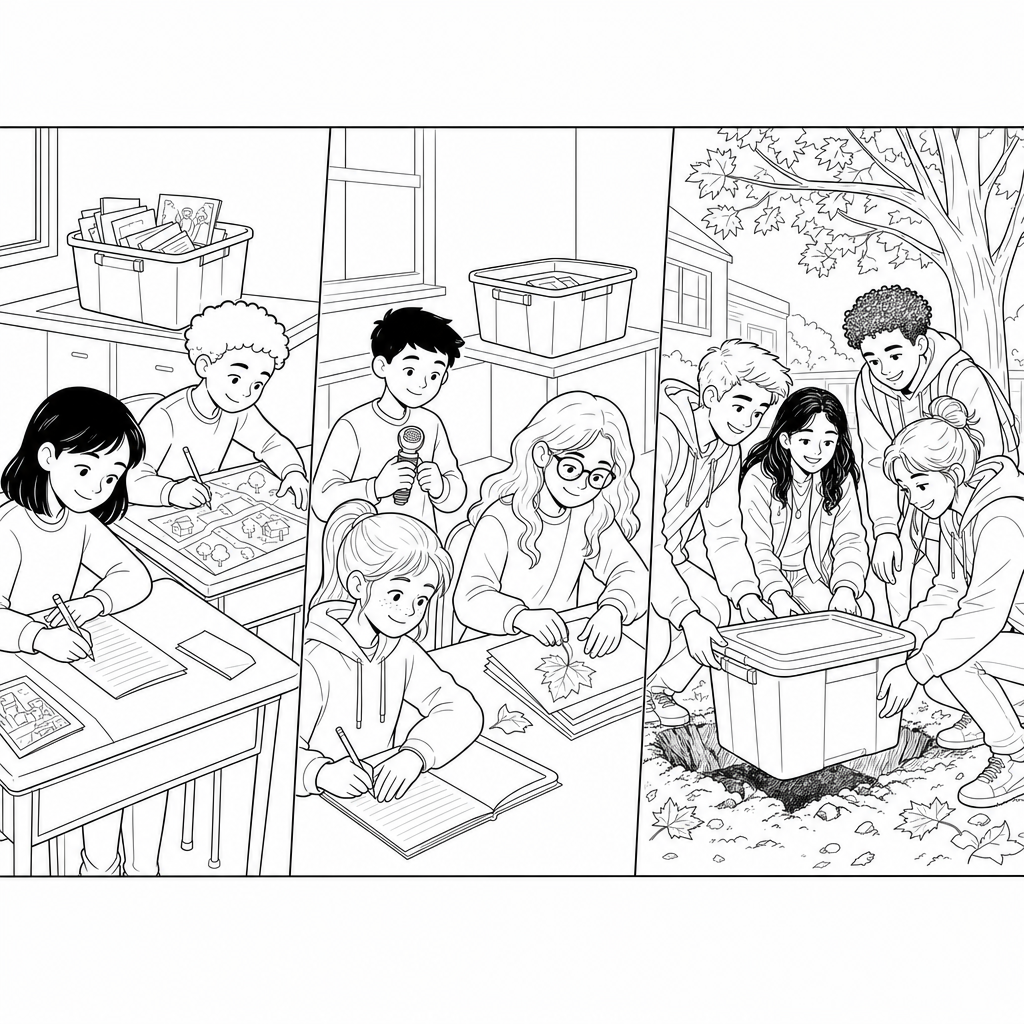
Last September, Mrs. Reyes told us we would build a time capsule. At first, I had imagined a fancy silver box, but ours turned out to be a sturdy plastic bin with a thick blue lid. She placed it on the back counter and said, "By June, this will hold a piece of every one of you." I had never thought a plain bin could feel so important, but somehow it already did. Each month, we added something new. In October, I wrote a letter to my future self. In November, my friend Theo drew a careful map of our neighborhood, including the bakery on Pine Street and the crooked tree near the bus stop. By January, we had collected drawings, photographs, predictions about the news, and even a list of slang words we use every single day. Mrs. Reyes said language changes faster than we notice, and our list would prove it later. Right now, the bin sits in the corner, half full and waiting. I walk past it every morning, and I think about what I still want to add. Today, I am writing a short essay about my grandmother, who moved here from the Philippines when she was twelve. She tells me stories about her old village, and I want the capsule to remember her voice too. My classmates are working on their own projects. Some are recording songs, while others are pressing autumn leaves between sheets of wax paper. Next June, on the last day of school, we will seal the bin with strong tape and bury it beneath the maple tree in the courtyard. Mrs. Reyes has promised that, ten years from now, our class will return to dig it up. By then, we will have grown into teenagers, and some of us will have moved to other cities. I will have finished middle school, started high school, and maybe even learned to drive. The thought feels strange and exciting at the same time. I wonder what I will think when I read my own letter again. Will I laugh at my handwriting? Will I remember why I chose to include a green guitar pick or a ticket stub from the science museum? My mother says that memory is slippery, and a time capsule is like a net that catches what would otherwise drift away. I had not understood her at first, but now her words make perfect sense to me. Before this project, I had believed that important history only happened to famous people in textbooks. I have learned, though, that ordinary days matter too. A Tuesday lunch, a silly joke, a drawing of a crooked tree — these things tell a story about who we are. When my future self finally opens the bin, she will meet a fifth grader who cared enough to save them. That, Mrs. Reyes says, is the real purpose of a time capsule: not to freeze time, but to send a careful message forward into a future we cannot yet see.
What this lesson checks
- Grammar usage: Which verb form correctly completes this sentence from the passage so that it uses the future perfect tense? "By then, we _____ into teenagers, and some of us will have moved to other cities."
- Grammar usage: Read this sentence from the passage: "Before this project, I had believed that important history only happened to famous people in textbooks." The verb "had believed" is in the past perfect tense. Explain why the author used the past perfect tense here instead of the simple past "believed." Then write one new sentence of your own about the narrator that correctly uses a past perfect verb.
- Grammar usage: Which sentence correctly uses the present perfect tense?
- Grammar usage: Which verb form correctly completes this sentence from the passage using the past perfect tense? "By January, we _____ drawings, photographs, predictions about the news, and even a list of slang words we use every single day."
- Grammar usage: The sentence below uses the wrong verb tense. The narrator is describing a future action that will be completed before another future moment (June), so the underlined verb should be in the future perfect tense. Rewrite the sentence with the correct verb form. Next June, by the time we seal the bin, we collect items for nine whole months. (Change "collect" to the future perfect tense.)
- Grammar usage: Which sentence correctly uses the past perfect tense?