Grade 4 · Week 4reasons evidence
Recycling Bins on Our Playground
Students read Maya's persuasive article proposing playground recycling bins, then answer five questions that identify her claim, reasons, and supporting evidence, with teacher and homeschool guidance included.
On screen - your kid, alone
- 1Day 1 - Meet the story
- 2Day 2 - Word work
- 3Day 3 - What it means
- 4Day 4 - Fix & re-read
- 5Day 5 - Show what you know
Offline - with you
Print the pages for offline work together; the answer key is for you.
Start by reading Maya's article together, then say something like, "Maya wants something to change at her school. What is she asking for, and what three reasons does she give?" A strong answer names the claim (add recycling bins to the playground) and lists all three reasons in the child's own words: lots of recyclables get thrown away, experts say recycling helps, and other places already do it successfully. Then push a little deeper by asking your child to match each reason to its evidence — the count of 47 juice pouches, what Mr. Ruiz and the city website say, and the cafeteria and Maple Street examples — and to label whether each piece of evidence is a fact, an expert source, or an example. A good response shows your child can tell the difference between a reason (the writer's point) and evidence (the proof behind it). If your child struggles, reread one paragraph at a time and ask, "What is Maya trying to convince us of here, and how do we know she isn't just guessing?" You can also have them underline numbers in one color and names of experts in another to make the evidence easier to spot.
Recycling Bins on Our Playground
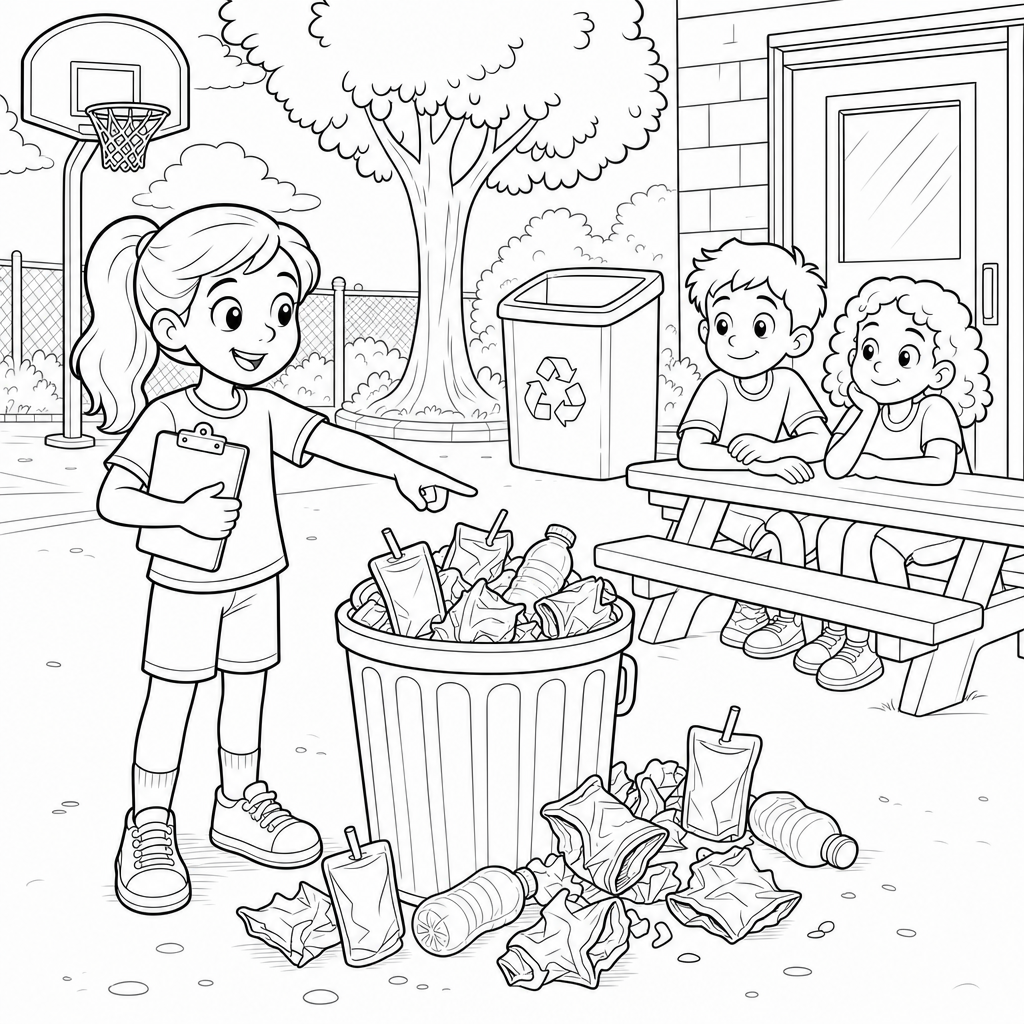
My name is Maya, and I am on the student council at Pine Hill Elementary. I think our principal, Ms. Carter, should put recycling bins on the playground after recess. Right now, we only have trash cans out there. That means every juice pouch, water bottle, and snack wrapper ends up in the landfill. I have three strong reasons why bins would help our school, our planet, and our students. My first reason is that a lot of recyclable trash is being thrown away each day. Last Tuesday, I helped check the playground trash cans with my teacher. I counted 47 empty juice pouches and 23 plastic water bottles in just one can. That was only one recess! If we add bins, most of those items could be recycled instead of buried in the ground. My second reason is that experts say recycling really does help our city. Mr. Ruiz, our school custodian, told me that the trash bags from recess are the heaviest of the whole day. He also said the city pays less when schools sort their waste correctly. The Greenville city recycling website agrees. It explains that one ton of recycled plastic saves enough energy to power a home for several weeks. That fact shows our small bins could make a real difference. My third reason is that other places at our school already prove this idea works. Our cafeteria has had blue recycling bins for two years. Mrs. Lopez, the cafeteria manager, said students fill them up at every lunch without any problem. Even Maple Street Elementary, just down the road, added playground recycling bins last fall. Their principal told our principal that students learned the rules quickly and kept the playground cleaner than before. For these three reasons, I believe Pine Hill should add at least two recycling bins next to the playground trash cans. We have the proof from our own trash counts. We have the support of experts like Mr. Ruiz and our city website. We also have a clear example from the cafeteria and from a neighboring school. Adding bins would not cost much, but it would teach every student a powerful habit. Please, Ms. Carter, give our playground the bins it needs. Together, we can keep our school cleaner and our planet healthier.
What this lesson checks
- Main idea: What is the author's main point in this article?
- Main idea: Which piece of evidence best supports Maya's reason that a lot of recyclable trash is being thrown away each day?
- Main idea: Maya writes that Mr. Ruiz told her the trash bags from recess are the heaviest of the whole day. In Maya's article, this sentence is an example of—
- Main idea: Which sentence from the article is a REASON Maya gives, not a piece of evidence?
- Main idea: Maya gives three reasons to add recycling bins to the playground. Which of her three reasons do you think is the STRONGEST, and why? Use specific evidence from the article to explain your thinking in 2-4 sentences.