Grade 4 · Extra practicenarrative response
The Pond Behind the Museum
Students read a short narrative model about a class trip discovery, then answer four questions on dialogue punctuation, sequencing words, and writing their own dialogue line, supported by teacher and homeschool guidance.
Offline - with you
Print the pages for offline work together; the answer key is for you.
Read the story aloud together once, then ask your child to point out the two lines where a character is speaking. Talk about what they notice: quotation marks wrap around the spoken words, commas or other punctuation sit inside the quotes, and a tag like "she whispered" tells us who is talking. A strong answer on the writing task will add one new line of dialogue that fits the scene (maybe Ms. Patel reacting, or the museum guide explaining), uses quotation marks correctly, and sounds like something that character would really say. Watch for sequencing words too—ask your child to find "first," "then," and "finally" and explain how those words help the story move in order. If your child gets stuck on punctuation, write a simple example together on scratch paper, like: "I see it!" Sam shouted. Then have them copy that pattern for their own new line. If they freeze on what to write, prompt them with a question such as, "What might the turtle have done next, and who would speak first?"
The Pond Behind the Museum
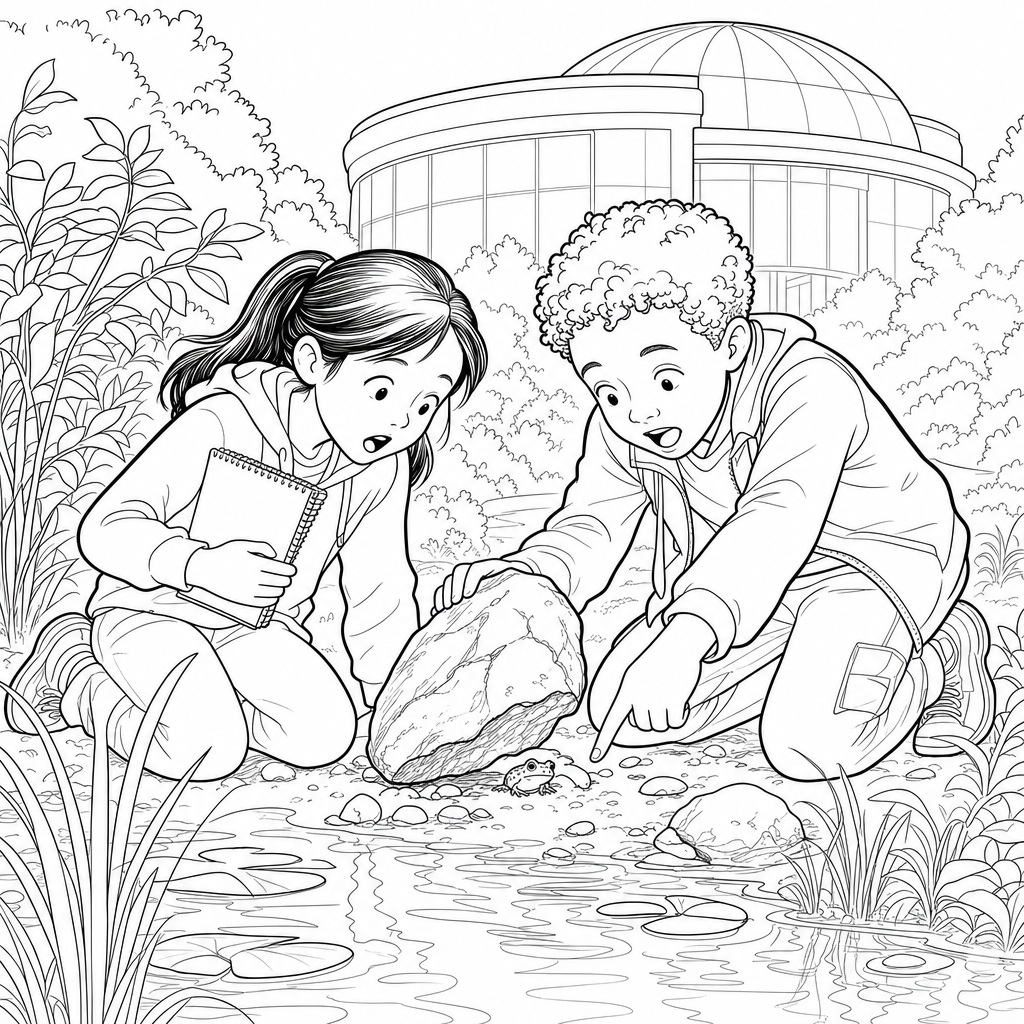
Our class trip to the science museum almost ended without a single surprise. First, we toured the dinosaur hall, where Mia and I sketched fossils in our notebooks. Then, during lunch, we wandered to the little pond behind the building. The water smelled like wet leaves and fresh rain. Mia knelt by the edge and gasped. "Look at this!" she whispered, pointing at a small green shell tucked under a rock. I leaned closer. The shell moved. A tiny turtle blinked up at us, no bigger than a cookie. "It must have wandered out of the exhibit," I said, my heart thumping. "We have to tell Ms. Patel right now," Mia answered, already standing up. We hurried back across the grass, careful not to scare the turtle. Ms. Patel listened, then smiled and called a museum guide. The guide knelt by the pond and gently lifted the turtle into a soft cloth. "You two are real scientists today," she told us. Finally, on the bus ride home, Mia grinned at me. I grinned back. Our class trip had become the best story of the year.
What this lesson checks
- Writing plan: Continue the story. Write 2-3 sentences that could come right after the last line. Include one new line of dialogue with correct punctuation, and keep the same voice as the model.
- Writing plan: Imagine you are on a class trip to a farm. You and a friend find a baby goat hiding behind the barn. Write 2-3 sentences about this moment. Include at least one line of dialogue with a speaker tag, and use correct quotation marks and punctuation.
- Writing plan: The model story tells what the narrator and Mia did, but it does not describe how the tiny turtle looked or felt up close. Write 1-2 sentences with a sensory detail about the turtle that could fit right after "A tiny turtle blinked up at us, no bigger than a cookie." Use sight, touch, or sound.
- Writing plan: A student wrote this weak draft about the turtle discovery: "Mia found a turtle by the pond. She told me to look at it." Revise this draft into 2-3 stronger sentences. Use at least one line of dialogue with correct quotation marks and a speaker tag, like the model story does.