Grade 4 · Extra practiceinformative paragraph
The Green Team in Action
Students read an informational article about Lincoln Elementary's Green Team recycling program, then answer four writing-focused questions with teacher and homeschool guidance provided.
Offline - with you
Print the pages for offline work together; the answer key is for you.
Start by reading the article together and telling your child, "This is an informative paragraph — its job is to explain how something works, not to share an opinion." After reading, ask them to point to one sentence that states the main topic and a few sentences that give facts (like the Friday pickup, the three bins, or the 200 pounds per month). Strong answers will use details directly from the passage and stay focused on explaining the recycling program, not on what the child thinks about recycling. For the short writing question, a good response uses 2–3 complete sentences and includes at least two specific facts from the article, such as who volunteers and what they sort. If your child gets stuck, reread one section aloud and ask, "What did you just learn here?" — then help them turn that answer into a sentence. If sentence ordering is hard, have them number the facts in the order they happened: pickup, sorting, truck, new products.
The Green Team in Action
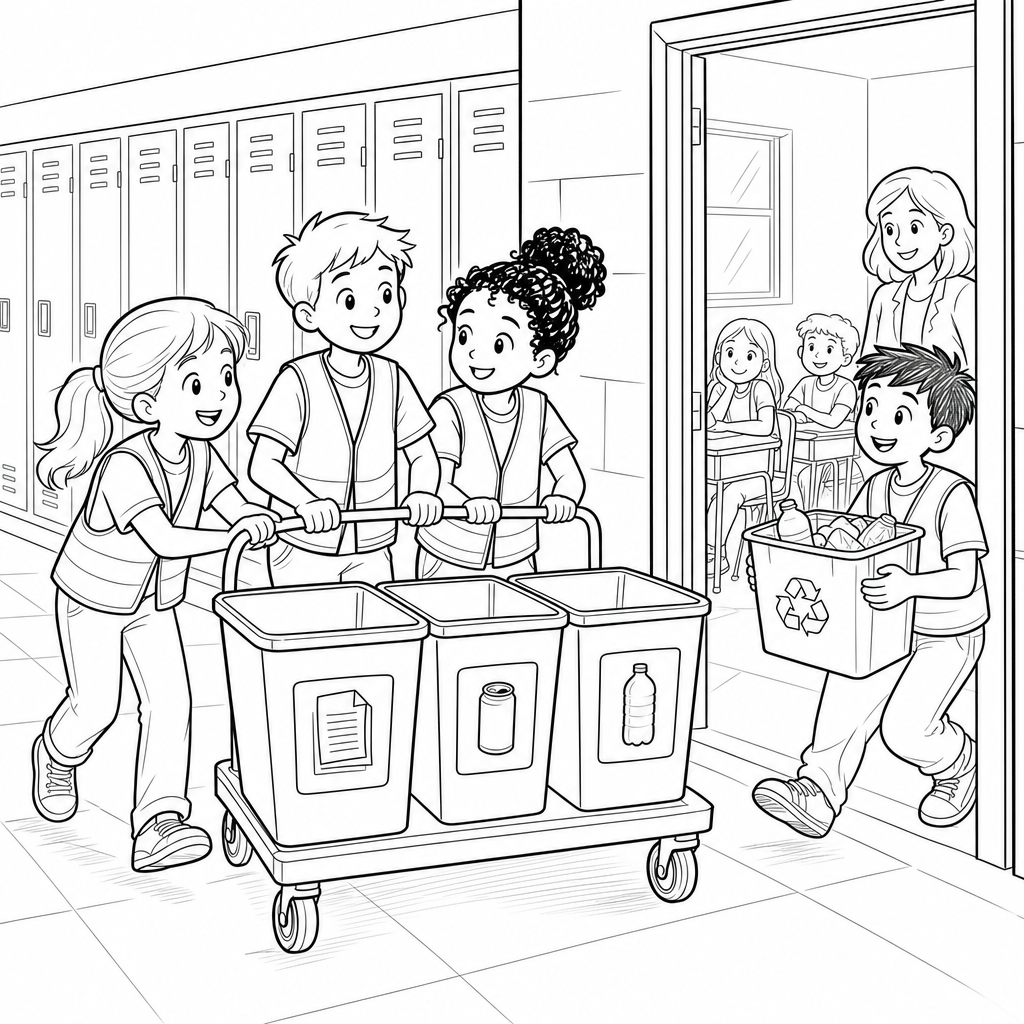
At Lincoln Elementary, students help keep the school clean and care for the planet. The Green Team is a group of volunteers from fourth and fifth grade who run the school recycling program. They meet every Friday to collect items that can be reused. Their work shows how kids can make a real difference at school. Each Friday morning, Green Team members visit every classroom in the building. They roll a large cart from room to room. Inside each classroom, there are three labeled containers. One is for paper, one is for aluminum cans, and one is for plastic bottles. Teachers remind students to drop the right items into the right bin all week long. When the Green Team arrives, the bins are usually full. After pickup, the volunteers bring the cart to the sorting room near the cafeteria. This is where the most important work happens. Students sort the items one more time to make sure nothing is mixed up. Paper goes into a tall blue bin. Aluminum cans go into a gray bin with a metal lid. Plastic bottles go into a green bin near the door. Sorting carefully is important because the city will not accept loads that are mixed together. A teacher named Mr. Ortega checks the bins before they leave the room. On Monday mornings, a city recycling truck pulls up to the back of the school. The driver loads the sorted bins and takes them to the city recycling center. There, the materials are cleaned, melted, or shredded so they can be turned into new products. Old paper might become a notebook. An empty can might become part of a bike. Used plastic bottles can even become carpet or new bottles. The Green Team has been busy this year. The school collects about 200 pounds of recycling each month. That adds up to more than a ton over the school year. Students also track their numbers on a poster in the main hallway. The poster shows how many pounds of each material the school has saved from the trash. Thanks to the Green Team, less waste leaves Lincoln Elementary in garbage bags. Instead, paper, cans, and bottles get a second life. The program proves that small actions, done every week by careful volunteers, can lead to big results.
What this lesson checks
- Writing plan: The article ends by saying the Green Team's small actions lead to big results. Continue the article in the same informational voice. Write 2–3 sentences that add the NEXT informational detail, such as how the Green Team plans to grow the program or how other students can help. Use facts and language that match the rest of the article.
- Writing plan: Imagine your school has a student-run school garden club. Write 2–3 informational sentences that explain HOW the garden club works. Use the same kind of informational writing the Lincoln Elementary article uses: name a clear topic, then give concrete facts (such as who, when, and what they do). Do NOT share your opinion about the garden club.
- Writing plan: Read this short informative model about a school book swap. It has a topic sentence and supporting facts, but it is MISSING a concluding sentence. Model: "At Jefferson Elementary, students run a book swap every month. The Reading Buddies club sets up tables in the library on the first Friday of each month. Students bring books they have already read and trade them for different ones. Last year, the club traded more than 300 books." Write ONE concluding sentence to finish the paragraph. Your sentence should wrap up the main idea and sound like informational writing (not an opinion). Use the same style as the Lincoln Elementary article.
- Writing plan: A student wrote this weak draft about the Green Team's sorting room: "The sorting room is cool. Kids do stuff there with the bins." This draft is too vague and sounds like an opinion. Revise it into 2–3 strong informational sentences. Use specific facts from the Lincoln Elementary article (such as where the sorting room is, what students do there, the color of the bins, or why careful sorting matters). Keep the third-person informational voice.