Grade 4 · Week 5context clues
Glaciers on the Move
Students read a grade-4 nonfiction science passage about glaciers and answer seven context-clue questions, supported by teacher and homeschool guidance for vocabulary instruction.
On screen - your kid, alone
- 1Day 1 - Meet the story
- 2Day 2 - Word work
- 3Day 3 - What it means
- 4Day 4 - Fix & re-read
- 5Day 5 - Show what you know
Offline - with you
Print the pages for offline work together; the answer key is for you.
Start by reading the passage aloud together, or take turns reading paragraphs, then tell your child the goal: "We're going to figure out what tricky words mean by looking at the words and sentences around them." Point out that the passage actually defines many of its hard words — for example, it tells us a glacier is "a thick mass of ice," meltwater is "water from melted ice," and a moraine is "a ridge of leftover material." Good answers will name the specific clue: your child should be able to point to the sentence or phrase that gave away the meaning, not just guess from the topic. For erosion, a strong answer connects it to "the slow wearing away of rock and soil," and for gravity, to "the force that pulls them slowly downhill." If your child struggles, slow down and reread just the sentence with the hard word plus the one before and after it, then ask, "Did the author tell us what this means, give an example, or say it a different way?" Celebrate when they catch a definition clue — that habit will help them with every science book they read.
Glaciers on the Move
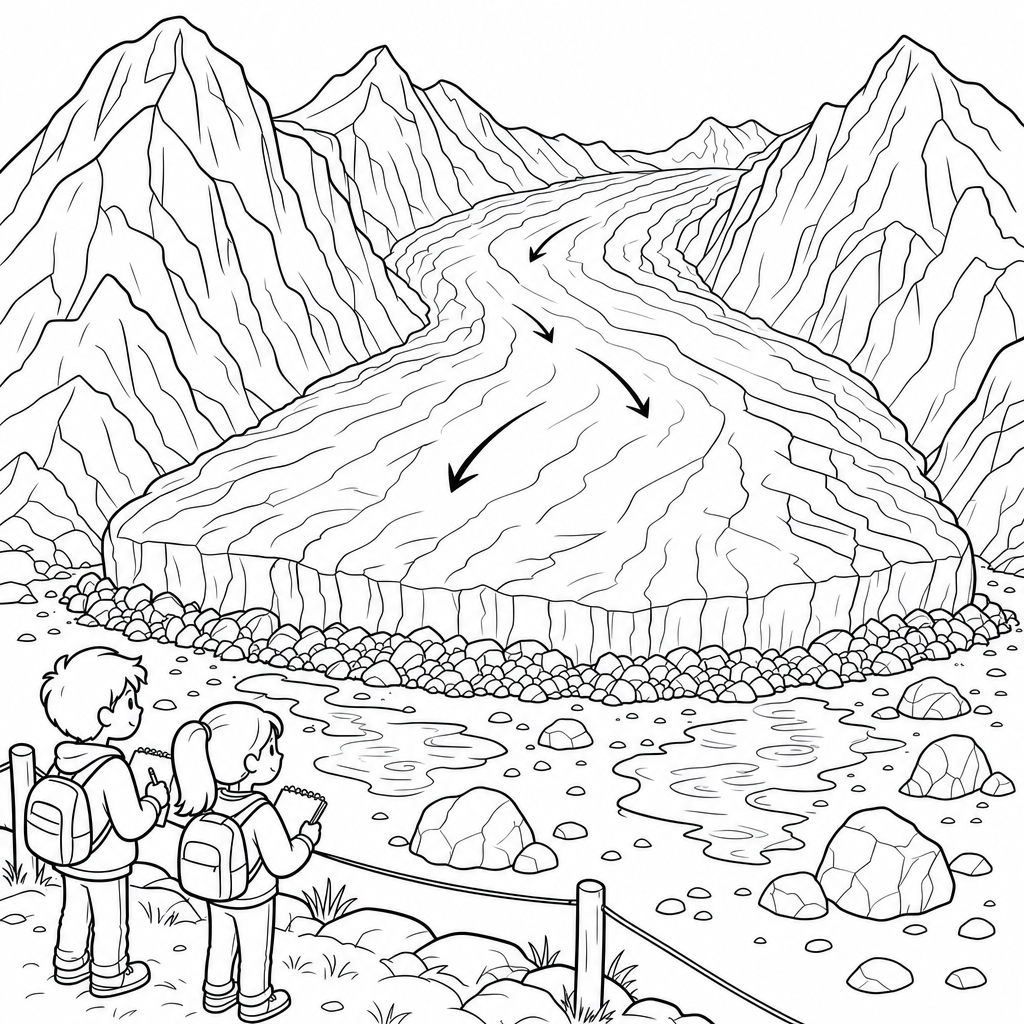
High in the mountains and near the poles, huge sheets of ice are slowly changing the land. These ice sheets are called glaciers. A glacier is a thick mass of ice that forms when more snow falls each winter than melts each summer. Year after year, the snow piles up. The weight of the new snow presses down on the old snow below. Over a long time, the bottom layers get packed so tightly that they turn into solid ice. Glaciers may look frozen in place, but they really do move. Gravity is the force that pulls them slowly downhill. Most glaciers creep along just a few inches each day, but some travel several feet. Near the bottom of a glacier, a thin layer of water helps the ice slide over rocks. This water is called meltwater, which means water from melted ice. Meltwater acts almost like grease under a heavy box, helping the giant ice mass shift forward. As a glacier moves, it reshapes the land in powerful ways. The ice picks up rocks, sand, and gravel and drags them along the ground. This scraping is a kind of erosion, the slow wearing away of rock and soil. Glaciers can carve deep valleys with steep sides and flat bottoms. They can also scratch long grooves into solid stone. Scientists study these marks to learn which way an ancient glacier once flowed. When a glacier finally melts back, it leaves piles of rock and dirt behind. These piles are called moraines. A moraine, or ridge of leftover material, can stretch for many miles. Some moraines form along the sides of a glacier, while others build up at the front, where the ice stopped moving forward. Large boulders may also be left far from where they started. For example, a rock the size of a car might sit alone in a field because a glacier carried it there thousands of years ago. Glaciers shape our planet in ways most people never see. The Great Lakes, many mountain valleys, and even some hills were formed by ice during the last ice age. Today, scientists watch glaciers closely because they are shrinking as the climate warms. By studying how glaciers form, flow, and fade, we learn about Earth’s past and get clues about its future. Slow, silent, and strong, glaciers are still on the move.
What this lesson checks
- Context evidence: Read this sentence from the passage: "This water is called meltwater, which means water from melted ice." What does the word meltwater mean?
- Context evidence: The passage uses the word erosion. Copy two short phrases from the passage that help you figure out what erosion means.
- Context evidence: Read this sentence from the passage: "When a glacier finally melts back, it leaves piles of rock and dirt behind. These piles are called moraines. A moraine, or ridge of leftover material, can stretch for many miles." What is a moraine?
- Context evidence: Pick one of these target words from the passage: gravity OR glacier. Write the word you chose, copy a short clue from the passage that helped you figure out what it means, and then explain the word in your own words.
- Context evidence: Read this new sentence: "After the heavy rain, erosion washed away part of the dirt road." Based on how the passage explains the word erosion, what does erosion mean in this new sentence?
- Context evidence: Read this sentence from the passage: "Large boulders may also be left far from where they started." Based on the example that follows in the passage, what is a boulder?