Grade 4 · Week 3authors purpose
The New Cafeteria Sorting Bins
Students read four short texts about new cafeteria recycling bins, answer five questions identifying each author's purpose with text evidence, and use teacher and homeschool guidance.
On screen - your kid, alone
- 1Day 1 - Meet the story
- 2Day 2 - Word work
- 3Day 3 - What it means
- 4Day 4 - Fix & re-read
- 5Day 5 - Show what you know
Offline - with you
Print the pages for offline work together; the answer key is for you.
Start by reading all four short texts aloud together, then ask your child a simple framing question: "Why do you think each writer wrote their piece — to share facts, to change someone's mind, to make us laugh, or to teach us how something works?" A strong answer will name the purpose AND point to specific words as proof, like noticing that Text B repeats "should" and "we must," or that Text C uses a talking banana peel and silly jokes. If your child can identify the purpose but struggles to find evidence, reread one paragraph together and underline two or three words that gave them the clue. If they mix up "inform" and "explain," talk about the difference: Text A reports what happened at the school, while Text D teaches how composting works in general. For a fun follow-up, have your child write a fifth short text about the bins with a purpose they choose, and see if you can guess it.
The New Cafeteria Sorting Bins
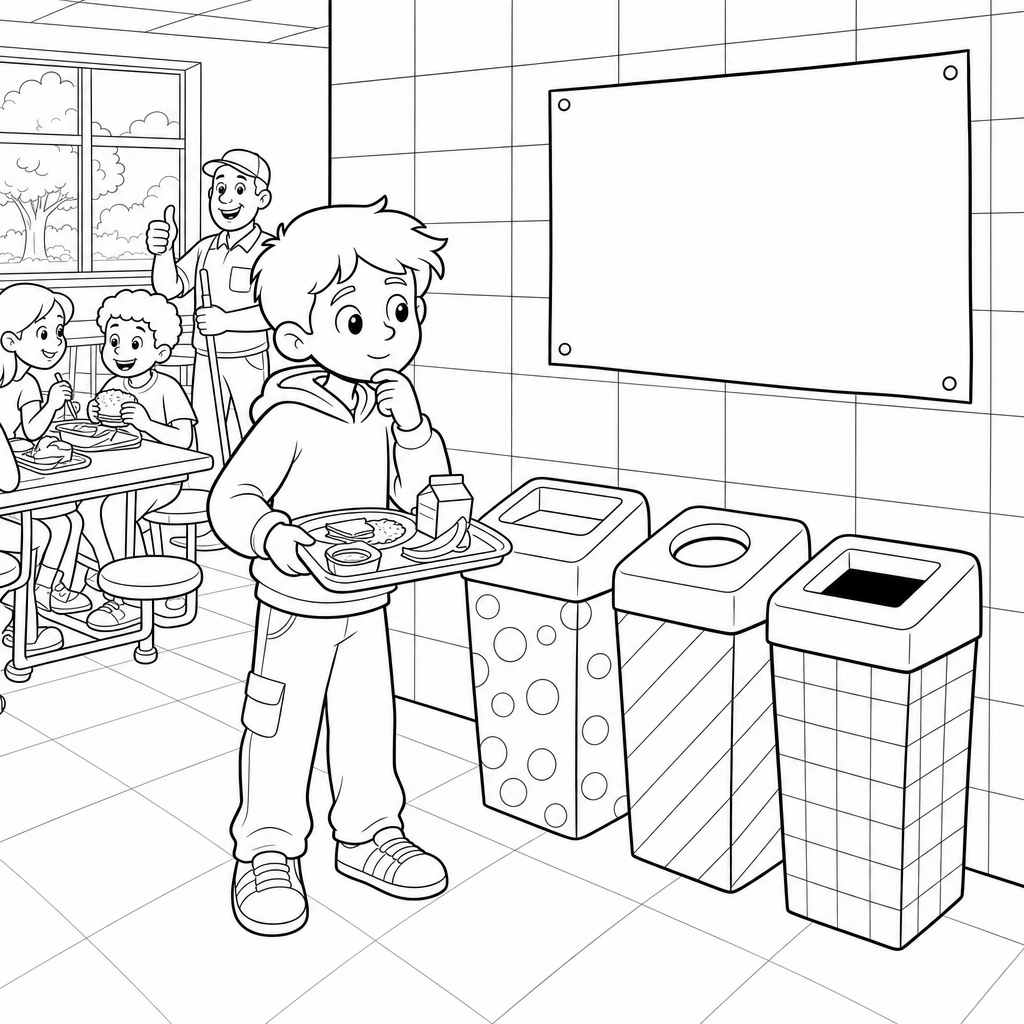
Text A Last Monday, three new sorting bins appeared in the Lincoln Elementary cafeteria. The bins were installed by workers from Greenway Services, who arrived before the breakfast bell. Each bin has a different color and label. The blue bin is for clean paper and cardboard, like milk cartons and napkins. The green bin is for food scraps, including fruit peels and crusts. The black bin is for true trash, such as plastic wrappers. Principal Diaz announced the change during morning announcements. Lunch monitors will help students during the first week. The school hopes the bins will reduce the amount of waste sent to the landfill. Text B Every student at Lincoln Elementary should pay attention to the new bins. Right now, too much food and paper ends up in the wrong place. We must do better, because our choices matter. Think about the apple core you tossed yesterday. In the green bin, it can become compost for a garden. In the black bin, it just sits in a landfill for years. Sorting takes only three extra seconds, but it makes a huge difference. Imagine our cafeteria as a model for other schools! If fourth graders lead the way, the younger students will copy us. Please, sort your trash today. Text C From the Secret Diary of a Banana Peel Dear Diary, today was wild. After Jordan finished his lunch, he held me over the bins and froze like a statue. His eyes darted between blue, green, and black. "Am I paper? Am I garbage? Am I a mystery?" he whispered. A fifth grader shouted, "Green, dude, green!" Jordan dropped me in with a soggy lettuce leaf who introduced herself politely. Meanwhile, a juice box rolled past, totally lost. I am told I will decompose into rich soil and possibly become a tomato. Honestly, becoming a tomato sounds like a glamorous retirement. Not every banana peel gets such an exciting career change. Text D Composting is the natural process of breaking down food scraps into soil. Tiny living things called microbes eat the scraps and release nutrients. Worms, heat, and moisture speed up the work. After several weeks, the pile turns dark, crumbly, and earthy. Gardeners then mix this finished compost into flower beds and vegetable patches to help plants grow strong.
What this lesson checks
- Main idea: What is the author's main purpose in Text A?
- Main idea: What is the author's main purpose in Text B?
- Main idea: Why did the author most likely write Text C?
- Main idea: Which phrase from Text B best shows that the author is trying to persuade readers?
- Main idea: Compare Text A and Text D. Both texts give information, but how is each author's purpose slightly different? Use specific evidence from BOTH texts to support your answer. Write 2-4 sentences.