Grade 3 · Extra practicenarrative response
The Missing Library Book
Students read a model narrative about a missing library book, then answer four questions analyzing sequence and transition words before writing their own school-set story.
Offline - with you
Print the pages for offline work together; the answer key is for you.
Read the story together and let your child enjoy it once before discussing. Then say something like, "This story shows the order things happened. Can you find the words that tell us what came first, next, and last?" A strong answer will point to words like *first, next, after that,* and *finally,* and explain that these words help readers follow the story in order. For the writing prompt, look for a clear beginning (something is lost), a middle (the child searches), and an end (the item is found or the problem is solved), plus at least two transition words and a complete thought in each sentence. If your child gets stuck, try telling the story out loud together first, then have them write it down one sentence at a time. You can also let them draw three boxes labeled Beginning, Middle, and End, and sketch or jot a few words in each before writing full sentences.
The Missing Library Book
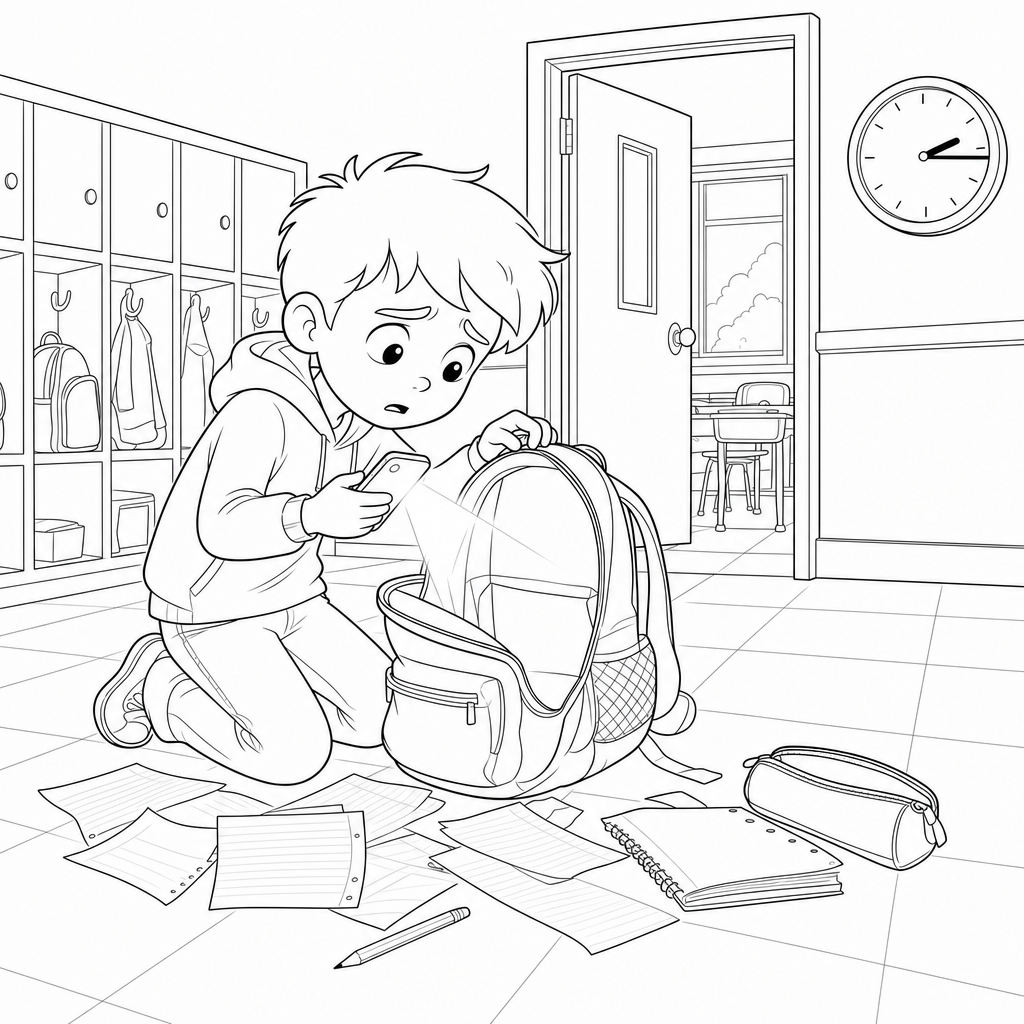
Maya's stomach flipped when she unzipped her backpack at morning meeting. The library book she had borrowed last week, a bright blue book about ocean animals, was gone. It was due back today, and Ms. Patel always reminded the class that returning books on time was important. Maya took a deep breath and decided to retrace her steps before the final bell. First, she checked the coat hooks in the hallway. She patted the pockets of her jacket and peeked into the cubby below, but the book was not there. Next, she hurried to the cafeteria, where she had eaten breakfast. The tables were already wiped clean, and the floor looked empty. After that, Maya remembered something important. She had stopped at the art room to drop off a folder before class. "Did anyone find a blue library book?" she asked Mr. Cole, the art teacher. He smiled and pointed to a shelf near the sink. There it sat, slightly damp from a splash of paint water, but safe. Maya felt a wave of relief wash over her. The smooth cover felt cool in her hands, and she could smell the sharp scent of fresh paint in the room. Finally, she walked straight to the library and placed the book on the return cart. Mrs. Hill thanked her for being responsible. As Maya headed back to class, she promised herself she would always double-check her backpack the night before. Losing the book had been scary, but retracing her steps had taught her something useful.
What this lesson checks
- Writing plan: The model story ends after Maya returns the book and walks back to class. Write 2-3 sentences that continue the story in the same voice. Show what happens next when Maya gets back to her classroom. Use at least one transition word (like then, next, after that, or finally) and include one small detail you can see, hear, or feel.
- Writing plan: Imagine you are at school and you cannot find your lunchbox in the cafeteria. Write 2-3 sentences about this moment. Use a sensory detail (something you see, hear, smell, or feel) the way the model story did when Maya was in the art room. Try to make the reader feel like they are right there with you.
- Writing plan: The model story shows Maya talking to Mr. Cole, but it does not show Mrs. Hill saying anything out loud. Add one line of dialogue for Mrs. Hill when Maya returns the book to the library. Write what Mrs. Hill says in quotation marks, and add a short sentence that tells how she says it or what she does.
- Writing plan: Here is a weak draft of an ending for a story about losing a jacket at school: "I looked for my jacket. I found it." This draft is missing transition words and a sensory detail. Revise the draft into 2-3 sentences. Use at least one transition word (like first, next, after that, or finally) and add one sensory detail (something you can see, hear, smell, or feel), the way the model story does.