Grade 3 · Week 5authors purpose
Three Texts About Recycling
Students read three short texts about school recycling bins, answer five questions identifying each author's purpose with evidence, and use teacher and homeschool guidance.
On screen - your kid, alone
- 1Day 1 - Meet the story
- 2Day 2 - Word work
- 3Day 3 - What it means
- 4Day 4 - Fix & re-read
- 5Day 5 - Show what you know
Offline - with you
Print the pages for offline work together; the answer key is for you.
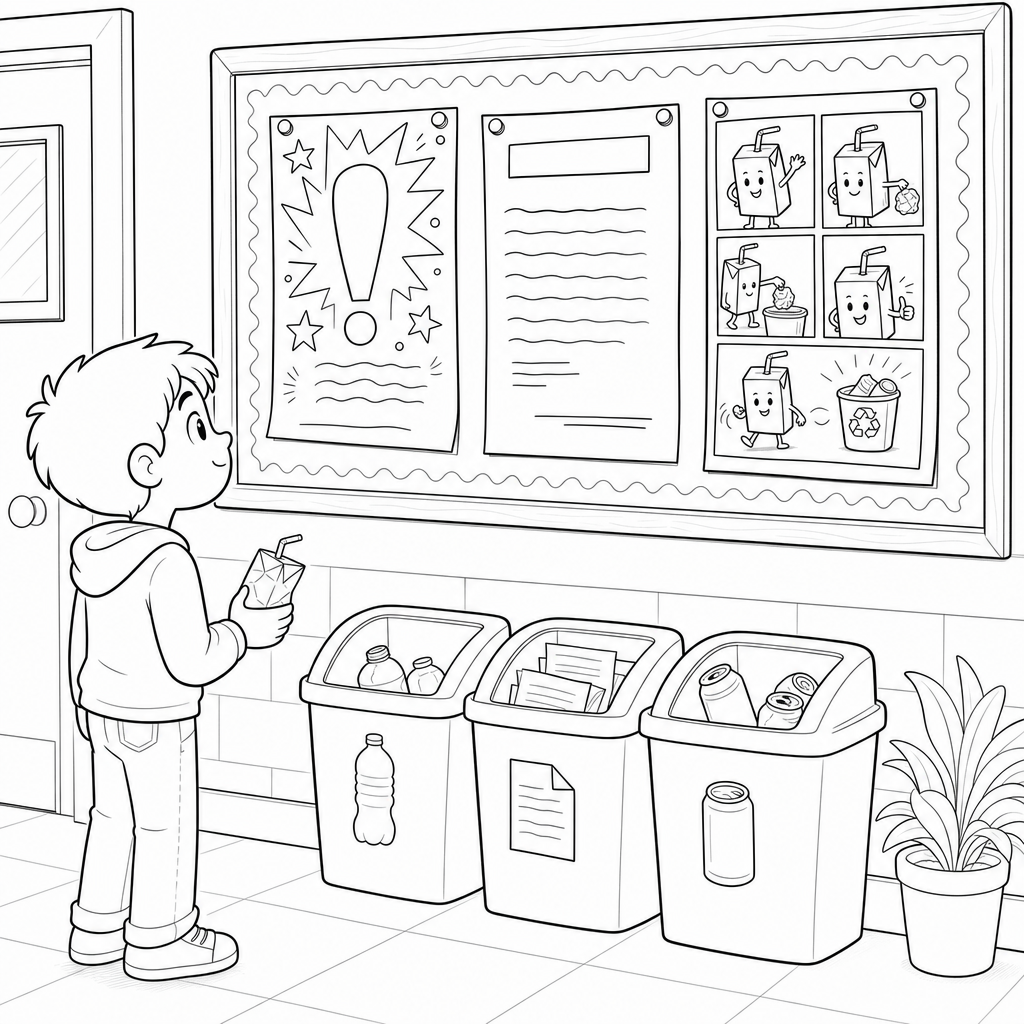
Sit next to your child and read all three mini-texts aloud together, then ask, "Why do you think each writer wrote their part?" Guide them toward the three purposes: to persuade, to inform, and to entertain. A strong answer names the purpose and points to a clue, like the exclamation points and "Join the Bin Brigade!" in Text 1, the bin colors and pickup days in Text 2, or the talking juice box in Text 3. If your child mixes up persuade and inform, ask, "Is the writer sharing facts or trying to change your mind?" If they miss the humor in Text 3, reread it in a goofy voice and ask whether it made them smile. Finish by having your child rewrite one sentence from Text 2 in a persuasive or silly way, so they feel how an author's choices shape the purpose.
Three Texts About Recycling
The Bin Brigade Our school should use the new recycling bins every single day! Throwing paper in the trash is wasteful, but recycling is the best choice for our classrooms. If we work together, we can fill the blue bins and shrink our garbage piles. Please remind your friends to sort their lunch trays. Join the Bin Brigade today! New Recycle Bins for School The new recycling bins arrived in our school last Monday. Each hallway has three bins with clear labels. The blue bin holds clean paper and cardboard. The green bin holds plastic bottles and metal cans. The gray bin is for regular trash. Custodians empty the bins on Tuesdays and Fridays. Students should rinse containers before tossing them inside. Teachers keep a smaller set of bins in every classroom. The Juice Box Jumble In Room 12, a juice box named Jiggy got very confused. He wobbled over to the gray bin and shouted, "I belong with the snacks!" A pencil shaving giggled and called him a silly straw. "Plastic friends go in the green bin," whispered a banana peel from the compost. Jiggy bounced three times, did a tiny flip, and landed perfectly in the green bin. The whole classroom cheered as if he had scored a goal.
What this lesson checks
- Main idea: What is the author's purpose for writing "The Bin Brigade"?
- Main idea: What is the author's main purpose for writing "New Recycle Bins for School"?
- Main idea: How is the author's purpose for "The Juice Box Jumble" different from the purpose for "New Recycle Bins for School"?
- Main idea: Which sentence from "The Bin Brigade" best shows that the author wants to persuade readers?
- Main idea: Imagine a classmate says all three texts have the same purpose because they are all about the recycling bins. Do you agree? Use details from at least two of the texts to explain why the authors had different purposes for writing.